A wall-mounted TV console in a non-air-conditioned HDB living room faces a constant, invisible assault. Singapore's 80% humidity is a material test; that sleek, flat-pack unit assembled last year can develop a soft, swollen edge by the next monsoon season. MDF, a budget favourite for its smooth finish, is a liability here—it acts like a sponge, warping irreversibly when exposed to sustained damp. The choice becomes non-negotiable: seek out solid wood like rubberwood or acacia, marine-grade plywood with a proper seal, or laminates specifically rated for moisture resistance. It's a upfront cost that prevents the quiet disappointment of a bulging cabinet door that won't close.
Scale is the next critical calculation. In a 4-room BTO living room, a 240cm console might dominate the entire feature wall, while a 120cm unit can look lost beneath a 65-inch TV. Use your bed size as an anchor—if your master bedroom fits a King (183cm), your living area can likely handle a console of similar length. But compact doesn't mean minimal; you'll need that storage. Factor in the inevitable tangle of gaming console wires, router cables, and spare remote controls. Built-in cable management, with rear cut-outs and perhaps a dedicated channel, isn't a luxury—it's what keeps a floating design looking clean instead of chaotic.
Consider the lived-in reality of the space, too. A sharp, unfinished corner on a console at shin-height is a hazard in a home with toddlers racing around. Rounded edges or a bullnose profile are sensible, not just stylistic. For households with pets, a glossy laminate might show every claw mark from an enthusiastic cat, while a textured wood veneer or a sintered stone top will hide a multitude of sins. The console becomes a piece of daily infrastructure, not just a display shelf.
Ultimately, the right unit reconciles these environmental and practical demands with the desired aesthetic. A floating console in a treated plywood, finished in a moisture-resistant matte lacquer, can offer the light, airy feel many want for a compact space while surviving the climate. It’s about specifying for the reality of your neighbourhood, whether you're in humid Bedok or a breezier Bukit Timah condo. You can browse a range of options built with these considerations at Megafurniture’s collection.
Budget, of course, directs the final decision. A full solid wood construction might push a 180cm console toward $2,400, while a well-engineered laminate version with a sturdy plywood core could be found around $1,200. The difference isn't just in the material cost, but in the engineering—the quality of the brackets for a wall-mounted design, the thickness of the shelves meant to hold a centre speaker, the precision of the drawer glides that will see daily use.
A flimsy cardboard backing is the first thing to buckle under Singapore's humidity, warping the entire console's silhouette against your feature wall. Insist on a proper anti-warp backing board—typically a dense fibreboard or plywood panel—screwed, not stapled, to the carcass. That's what keeps the unit square and prevents that unsightly, bulging centre panel you see in so many older HDB flats. Ignoring this is a classic false economy, especially for longer consoles spanning 180cm or more where structural rigidity is paramount. It’s a detail you can't see once installed, but you'll certainly notice if it fails.
Full-extension glides aren't a luxury; they're a necessity for accessing the back of deep drawers where routers and power banks inevitably migrate. The cheap, partial-extension runners common on budget units leave a good 30% of your storage space functionally useless. Quality glides will have a soft-close function and a rated load capacity—look for at least 15kg per pair to handle game consoles and AV receivers. Test them in the showroom with a firm, weighted pull; any wobble or grating sensation means they won't last the year. Good ones operate with a hushed, dampened motion that feels expensive.
Those slim, included wall brackets often have a maximum weight rating that doesn't account for your actual gear. For a fully loaded 240cm console, you need heavy-duty steel brackets rated for at least 80kg, and you must match the fixing to your wall type. Using masonry anchors in a partition wall is a disaster waiting to happen—the entire unit can pull free under load. In many BTO flats, you're drilling into a concrete beam or using specialised hollow-wall anchors for the stud-and-plaster sections. This isn't a place for guesswork or using the supplied screws if they seem inadequate.
That high-gloss laminate finish looks stunning under showroom lights, but in a typical living room with open windows, it becomes a relentless dust magnet and shows every fingerprint. For families, a satin or textured woodgrain finish in a mid-tone colour hides daily smudges and is far more forgiving. Gloss also highlights any minor imperfections in your wall, demanding a perfectly flat plastering job most resale flats simply don't have. The choice often comes down to a weekly chore versus a wipe-down every few months, which for most Singaporean households isn't really a choice at all.
Buyers routinely underestimate the sheer volume of miscellany that needs hiding: not just the PlayStation and soundbar, but the router, fibre modem, multiple power strips, a tangle of HDMI cables, and perhaps a set-top box. A console with only fixed shelves and no adjustable or concealed compartments quickly becomes a cluttered mess. Plan for at least one deep, ventilated compartment for heat-generating electronics and several smaller drawers for remote controls and batteries. The clean, minimalist look you're after depends entirely on having a designated, hidden spot for every single item—otherwise, it all ends up on top.
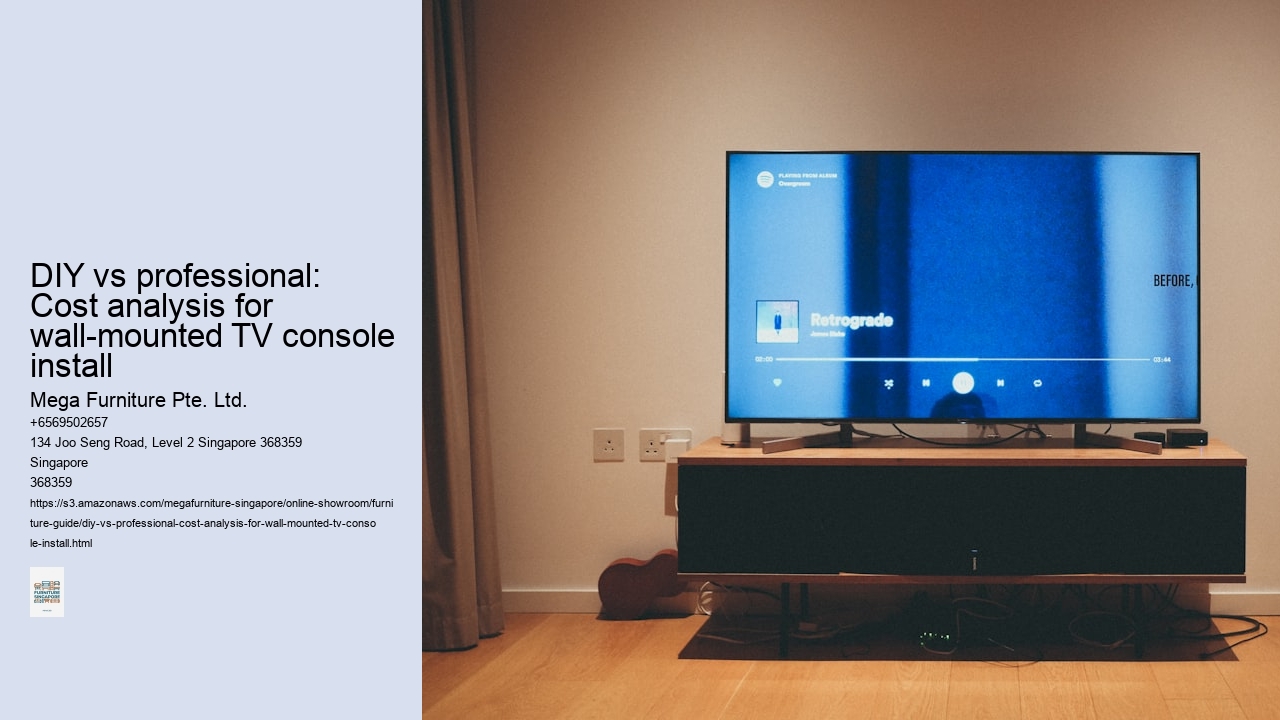
A new wall-mounted TV console arrives flat-packed in your Pasir Ris lift lobby, and that’s when the real decision starts. The bracket alone will set you back $80 to $150, but that’s just the hardware; you’ll also need a decent drill, a stud finder, a spirit level, and the confidence to drill into your HDB’s concrete walls. Labour is your own—budget a full Saturday afternoon, around four to six hours, for assembly, mounting, levelling, and cable management. Professional installation, by contrast, typically quotes a flat $200 to $400. That fee covers the entire job: mounting, precise levelling, and securely anchoring the unit to the wall. For many homeowners, especially those in newer BTO flats, that price buys peace of mind—it’s a fixed cost that eliminates the weekend’s uncertainty. The risk calculus here is specific to Singaporean homes. A DIY misstep can chip or crack the pristine finished walls in a five-room BTO, a repair that mars the minimalist look and can be costly to rectify. More critically, drilling into the wrong spot or misjudging the load distribution can lead to a catastrophic failure; a 180cm console loaded with a soundbar and gaming consoles is heavy, and its failure risks your TV and everything on the shelves. There’s also the matter of warranties. Some manufacturers or retailers will void the product warranty if installation isn’t performed by a certified professional, a clause often buried in the fine print. That potential voidance, combined with the risk to your flat’s finishes, shifts the value proposition for many—turning what seems like a straightforward DIY project into a professional job worth the centre. You can
browse the wall-mounted optionswith a clearer sense of the total commitment required. Ultimately, the choice hinges on your tolerance for hidden costs. The DIY route appears cheaper until you factor in tool purchases, your own time, and the very real possibility of damaging that perfect feature wall you spent months planning.
The grain on a rubberwood veneer looks convincingly rich online, but it's the lacquer's tackiness under your fingernail that tells you it won't last five years in a humid Tampines living room. That's why a showroom visit isn't just a browse; it's a technical inspection for a piece that'll hang on your wall. At the Joo Seng or Tampines showrooms, you can assess the structural heft firsthand. Pull out every drawer — a smooth, full-extension glide on metal runners is a given for quality, while a wobble or a hollow thud suggests compromises inside. Inspect the joinery at the corners; proper dovetail or mortise-and-tenon joints in solid wood frames are visibly different from simple butt joints glued and pinned, which might struggle with the load of a 75-inch TV and its accessories. Scale is notoriously difficult to judge from a product shot. Showrooms typically have mock-up HDB wall panels, allowing you to visualise how a 240cm console will dominate your 4-room BTO living room, or if a 180cm unit leaves enough space for your existing sideboard. You can also clarify critical details with staff: load specifications for your particular model, and installation requirements specific to local wall types, whether it's a new BTO's drywall or a resale flat's older plaster. Ultimately, you're verifying that the piece you're committing to, which will organise your media equipment and become a focal point, matches the promise of its online listing. It’s a chance to move from pixels to physicality, ensuring the finish and function align with your investment before it arrives at your door. You can
browse the options online, but the decision should be made in person.
The 2.4-metre TV console you’ve chosen will almost certainly arrive flat-packed. That’s a logistical necessity, not a design choice, dictated by the narrow lift landings and tight stairwells of most HDB blocks and older condos. Delivery crews are adept at navigating these spaces, but you’ll want to confirm the box dimensions against your entryway’s pinch points—especially in five-room BTO flats where the service yard door might be the only viable route.
Assembly is where the critical distinction lies. Many services will merely construct the unit on your living room floor, leaving you with a fully assembled, free-standing cabinet. For a true wall-mounted installation, you need confirmation that the service includes physically securing the console’s mounting bracket to a solid concrete or brick wall. This isn’t just about hanging it; it’s about ensuring the structural integrity of the entire installation, which demands proper hardware and often a separate site survey.
Warranty terms require similar scrutiny. A warranty that only covers surface scratches or finish discolouration is of little comfort if the mounting system fails. You’re looking for explicit coverage of structural integrity—the frame, joints, and that critical wall-mounting hardware—against manufacturing defects. Typical coverage periods range from 12 to 24 months, which is fairly standard; anything less should give you pause.
That moment when you finally hang your 75-inch TV above the console is when you’ll appreciate this diligence. The peace of mind comes from knowing the long, low silhouette isn’t just stylish, but securely anchored. For a range of options that typically include these clarified services, you can browse Megafurniture’s collection.
Always request the warranty documentation in writing before purchase, and clarify who bears the cost if a defect necessitates a full dismantle-and-reinstall. It’s a rare scenario, but one that turns on the fine print.
A common Google search from Tampines to Jurong West begins with a worried "can my wall hold it?"—specifically, whether a floating console can support a new 65-inch television. The short answer is yes, but it hinges entirely on the bracket's weight rating and, more critically, hitting the structural studs behind your drywall. A console rated for 40kg loaded weight is a bare minimum; for that size of TV, you'll want a bracket with a significant safety margin, and it must be bolted directly into concrete or solid timber studs, never just plaster or hollow blocks.
Safe for HDB false wall? Only with serious reinforcement. Many BTO flats feature a decorative false wall in the living room, which is typically just a timber frame clad in gypsum board—it can't bear a loaded console on its own. A contractor will need to open a section to install a plywood or steel backing plate between the studs, creating a solid anchor point for the mounting hardware. It's a messy but necessary step; skipping it risks the entire unit pulling away from the wall.
For a console facing a humid, corridor-exposed wall in a Pasir Ris or Bedok flat, material choice is everything. Laminated particleboard will swell over time. Teak is a classic, resilient option, while properly sealed and treated marine-grade plywood offers a more budget-friendly alternative that stands up to Singapore's moisture. The finish matters, too; a fully sealed, painted edge banding is far better than raw, exposed board edges that act like sponges.
Does the stated length include overhang? Almost always yes—a 180cm console is 180cm of furniture. That's why you must measure your exact wall space, accounting for clearance on either side for curtain stacks, door swings, or air-con units. A unit that fits wall-to-wall looks custom, but even a centimetre of overhang into a walkway becomes a shin hazard in a tight 4-room layout.
The moment you’ve finalised your design and chosen your unit is precisely when you should pause. That final invoice, whether it’s $1,200 for a straightforward unit or $4,500 for a full feature wall, needs a last, hard reconciliation with your own risk tolerance. A buyer’s excitement can easily outpace their practical assessment of what the install will actually demand.
For complex builds—say, a full-width sintered stone feature wall in a 4-room BTO with integrated LED coving and concealed wiring channels—hiring a professional isn’t a luxury, it’s a necessity. The margin for error is millimetre-thin, and the cost of correcting a misaligned mount or a poorly supported section far exceeds the initial outlay for skilled labour. Conversely, mounting a standard 180cm engineered wood console onto a bare concrete HDB wall is a project a competent DIYer can handle, saving perhaps $300 to $800 on installation fees. The distinction hinges entirely on your wall’s condition and the console’s design.
This is where specificity is non-negotiable. Pull out your tape measure again and confirm every dimension against your specific TV model’s VESA pattern and your room’s layout. A 65-inch TV on a 140cm console will look awkwardly top-heavy; your planned soundbar might completely obscure that top drawer you wanted to use. Consider the room’s traffic flow, too—a floating console in a narrow corridor-like living room needs enough clearance so feet don’t constantly scuff its underside.
Ultimately, the goal is a seamless integration that looks intentional, not like an afterthought. While a professional ensures that finish, a successful DIY install delivers a particular satisfaction, plus more budget for the TV itself. You can explore a range of wall-mounted options suitable for different skill levels at Megafurniture’s collection. Just remember, the most common regret isn’t spending too much on professional help; it’s realising too late that the job was beyond one’s own skills, leaving a costly, half-finished project dominating the living room wall.
In Singapore's living rooms, the television often dictates the furniture layout - and a console that's too long can overwhelm the entire space. It's a common mismatch: a 75-inch TV arrives, demanding a 240cm unit, but in a 20 sqm BTO living room, that console can eat up an entire wall. The proportions feel off, the room cramped. A TV console anchors the wall opposite the sofa in the same way a tall bookshelf anchors a corner — long horizontal piece, mix of open and closed storage, defines the visual weight of one whole side of the room. Megafurniture's TV Console range covers floating wall-mounted designs, low-profile freestanding consoles, and modular feature-wall configurations. Most pieces sit at 40-50cm height, sized for screens up to 75 inches.. That's why console scale isn't just about the screen; it's about your floor plan.
For a 40-inch TV, a 120cm console typically fits neatly into a corner or beside a window in a new BTO. Resale flats and older condos, with their less predictable layouts, might accommodate longer units, but you'll need to measure your clear wall space, not just the TV width. A 240cm console in a 20 sqm HDB area becomes a monolithic feature - it can work, but only if you're willing to sacrifice other furniture. In many compact homes, the solution is to go vertical: wall-mounted storage reclaims that precious floor space instantly.
The rule of thumb is simple: console length should match TV size. A 40-inch screen pairs with a 120cm unit; a 75-inch needs around 240cm. This maintains visual balance and prevents the TV from looking like it's floating adrift. Display cabinets sit between bookshelf and storage cabinet in function — closed glass-front protection for the items you want visible but not collecting dust. Megafurniture's Display Cabinet range covers glass-front, curio, wall-mounted, and freestanding configurations in solid wood, MDF, and metal-framed constructions. Average pricing for glass-front variants sits around $271, with LED-lit and motorised-shelf models commanding the higher tier.. But beyond that, you've got to consider the room's own dimensions. A 25 sqm condo living area might handle a 240cm console with room for a sofa opposite, but in a narrower 4-room resale layout, that same unit could block a walkway. Always leave at least 60cm for circulation.
Material choice plays a part here, too. A bulky, solid-wood floor-standing console feels heavier and more dominant than a sleek, wall-mounted design in sintered stone or lacquered MDF. The latter seems to hover, creating an illusion of more square footage - a small visual trick that makes a real difference in our typically tight spaces. For those prioritising floor space, the wall-mounted option is hard to beat; it's essentially storage without a footprint.
Ultimately, getting the scale right means measuring twice. A Bookshelf earns its place in Singapore homes through dual function — book and decor storage in the open shelves, soft visual division when placed mid-room in open-plan condominium layouts. Megafurniture's combined display unit and bookshelf hub covers tall book racks, cubby-hole designs, ladder shelves, modular cube systems, and glass-door pieces in oak, walnut, and MDF veneer finishes. Solid-wood pieces typically start around $425, with most heights spanning 120cm to 220cm to fit standard 2.6m HDB ceilings.. You'll want to account for your media components, any decorative items, and that essential cable management box. A well-proportioned console should frame the TV, not fight with it - and in Singapore, where every square metre counts, that balance is everything. You can explore a range of sizes and mounting options to find your fit.
In Singapore’s living rooms, the television often dictates the furniture layout — and a console that’s too long can overwhelm the entire space. It’s a common mismatch: a 75-inch TV arrives, demanding a 240cm unit, but in a 20 sqm BTO living room, that console can eat up an entire wall. The proportions feel off, the room cramped. That’s why console scale isn’t just about the screen; it’s about your floor plan.
For a 40-inch TV, a 120cm console typically fits neatly into a corner or beside a window in a new BTO. Resale flats and older condos, with their less predictable layouts, might accommodate longer units, but you’ll need to measure your clear wall space, not just the TV width. A 240cm console in a 20 sqm HDB area becomes a monolithic feature — it can work, but only if you’re willing to sacrifice other furniture. In many compact homes, the solution is to go vertical: wall-mounted storage reclaims that precious floor space instantly.
The rule of thumb is simple: console length should match TV size. A 40-inch screen pairs with a 120cm unit; a 75-inch needs around 240cm. This maintains visual balance and prevents the TV from looking like it’s floating adrift. But beyond that, you’ve got to consider the room’s own dimensions. A 25 sqm condo living area might handle a 240cm console with room for a sofa opposite, but in a narrower 4-room resale layout, that same unit could block a walkway. Always leave at least 60cm for circulation.
Material choice plays a part here, too. A bulky, solid-wood floor-standing console feels heavier and more dominant than a sleek, wall-mounted design in sintered stone or lacquered MDF. The latter seems to hover, creating an illusion of more square footage — a small visual trick that makes a real difference in our typically tight spaces. For those prioritising floor space, the wall-mounted option is hard to beat; it’s essentially storage without a footprint.
Ultimately, getting the scale right means measuring twice. You’ll want to account for your media components, any decorative items, and that essential cable management box. A well-proportioned console should frame the TV, not fight with it — and in Singapore, where every square metre counts, that balance is everything. You can explore a range of sizes and mounting options to find your fit.